Origins in Industrial Geothermal Cogeneration
Unlike natural hot springs that seep organically through mountain fissures, the Blue Lagoon was formed indirectly through modern energy infrastructure. In 1976, the newly constructed Svartsengi geothermal cogeneration plant began drilling exploratory boreholes into the volcanic bedrock of the Reykjanes Peninsula. The goal was to extract superheated geothermal fluid—reaching temperatures up to 240°C—to generate domestic electricity and deliver municipal district heating to neighboring communities.
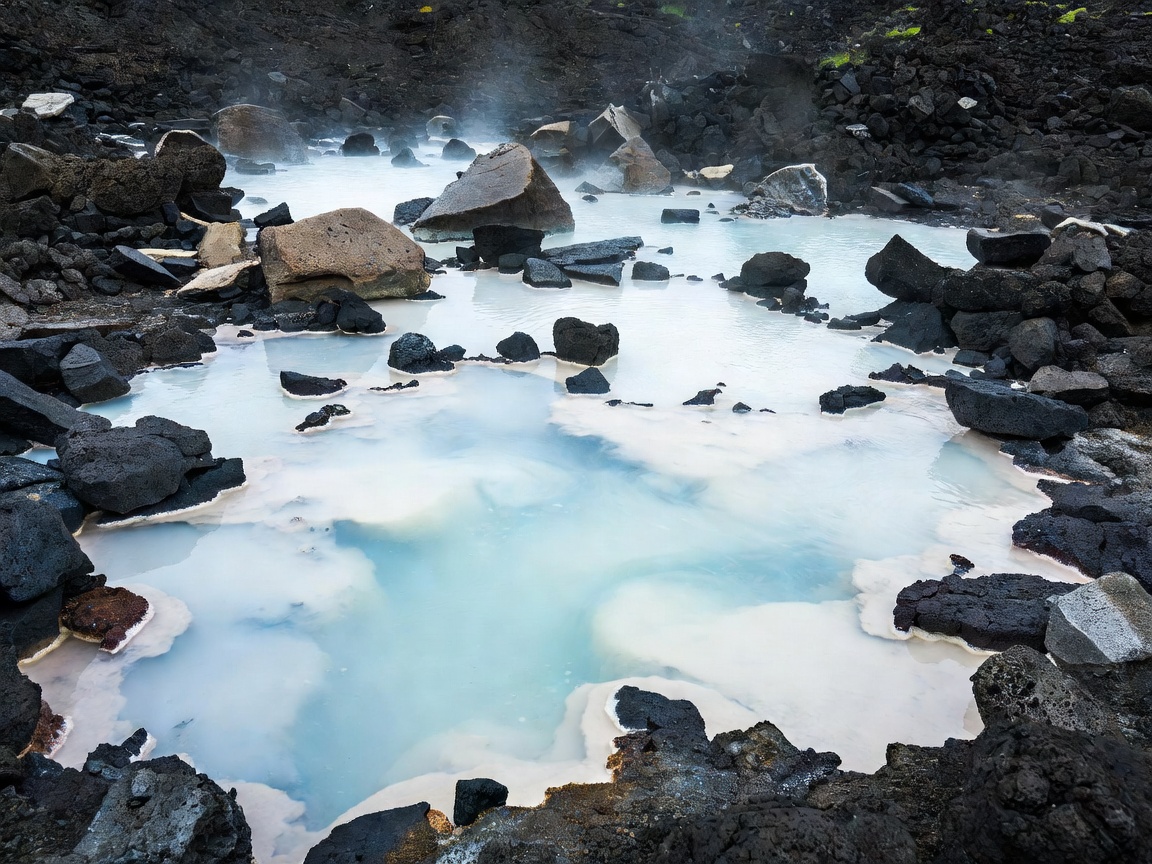
Once this deep subterranean water had passed through steam turbine heat exchangers, the residual mineral brine was discharged onto the porous Illahraun lava field, which dates back to a volcanic eruption in the year 1226. Civil engineers anticipated that the runoff would filter naturally down through the porous basalt rock back into the deep subterranean strata. However, the mineral makeup of the discharge defied expectations: as the water cooled to 38°C–40°C upon contact with the atmosphere, dissolved silica polymerized and precipitated out of solution. This created a dense, impermeable white clay lining over the volcanic rock, stopping drainage and forming the sprawling milky-blue reservoir seen today.
The Chemistry of Milky Aquamarine Water
The distinctive aesthetic of the Blue Lagoon is a direct result of optical physics and hydrothermal chemistry. The fluid in the lagoon is unique because it is composed of approximately 70% ocean seawater and 30% freshwater runoff drawn from subterranean aquifers approximately 2,000 meters beneath the ground. At that extreme depth and pressure, the water leaches minerals directly from the volcanic basalt.
The primary suspended constituent is colloidal silica (silicon dioxide, SiO₂), accompanied by trace amounts of mineral salts, calcium, and endemic cyanobacteria (*Cyanothece* strains). The intense milky-cyan coloration is produced by Rayleigh scattering: the suspended microscopic silica crystals deflect shorter wavelengths of sunlight (blue and green) more strongly than longer red wavelengths. On overcast winter days, the lagoon appears as an opaque milky white, while on bright summer mornings it shifts into a vivid azure.
Geological Notice for Visitors: Due to ongoing volcanic unrest along the Sundhnúkagígar crater chain on the Reykjanes Peninsula, check the Icelandic Meteorological Office (Veðurstofa Íslands) for active seismic advisories and road accessibility before booking or departing.
Comparative Evaluation: Merits and Trade-Offs
When assessing the Blue Lagoon as an environmental bathing destination, travelers must weigh its clinical dermatology benefits against its high commercial density:
Key Advantages
- Verified Dermatological Qualities: The bioactive silica mud has been documented in clinical trials to assist patients suffering from chronic psoriasis and eczema by strengthening skin barrier cohesion.
- Continuous Water Refreshment: The hydraulic discharge from the Svartsengi plant pumps roughly 900 cubic meters per hour through the reservoir, completely replacing the water volume every 40 to 48 hours without chemical chlorination.
- Proximity to Keflavík Airport: Positioned only 20 minutes from Iceland's international gateway, making it an efficient arrival or departure itinerary point.
Documented Trade-Offs
- Mandatory Pre-Booking: Entry is strictly managed through tiered reservations; spontaneous walk-in visits are consistently turned away.
- Severe Hair Stiffening: Colloidal silica coats hair follicles like glue. Without copious leave-in conditioner, bathers will experience brittle, broom-like hair texture for several washes.
- Commercial Density: During midday peak hours, the central swimming areas host large volumes of international tour groups, which detracts from the quiet solitude of wilder springs.
Operational Specifications & Comparison
The table below summarizes the key hydrological indicators and admission parameters for the Blue Lagoon facility:
| Parameter | Facility Metric | Standard Icelandic Spring |
|---|---|---|
| Average Water Temperature | 37°C – 39°C (98°F – 102°F) | 38°C – 42°C |
| Primary Dissolved Mineral | Silica (SiO₂) & Marine Salts | Sulfur (SO₄) & Iron |
| Water Salinity | Approx. 2.5% (Brackish) | < 0.05% (Pure Fresh) |
| Water Volume Turnover | Complete every 40 hours | Continuous passive flow |
| Footwear Policy | Clean slippers outside water | Barefoot / Aquatic sandals |
Preparation and Practical Visitor Rules
To preserve pool safety and personal comfort, visitors should observe standard Nordic bathhouse procedures. Remove all silver, bronze, and plated jewelry before entering the changing rooms. Airborne hydrogen sulfide and marine salts cause rapid, permanent oxidation and discoloration of jewelry metal.
Upon entering the gendered locker rooms, naked pre-wash with soap in the shower stalls is compulsory. Apply the complimentary conditioner liberally to the ends of your hair and tie it up before wading into the water. Silica mud mask stations are located along the wooden walkways inside the lagoon; apply the mud to facial skin, leave it to dry for 5 to 10 minutes until chalky white, and rinse it off directly into the water using gentle circular motions.